

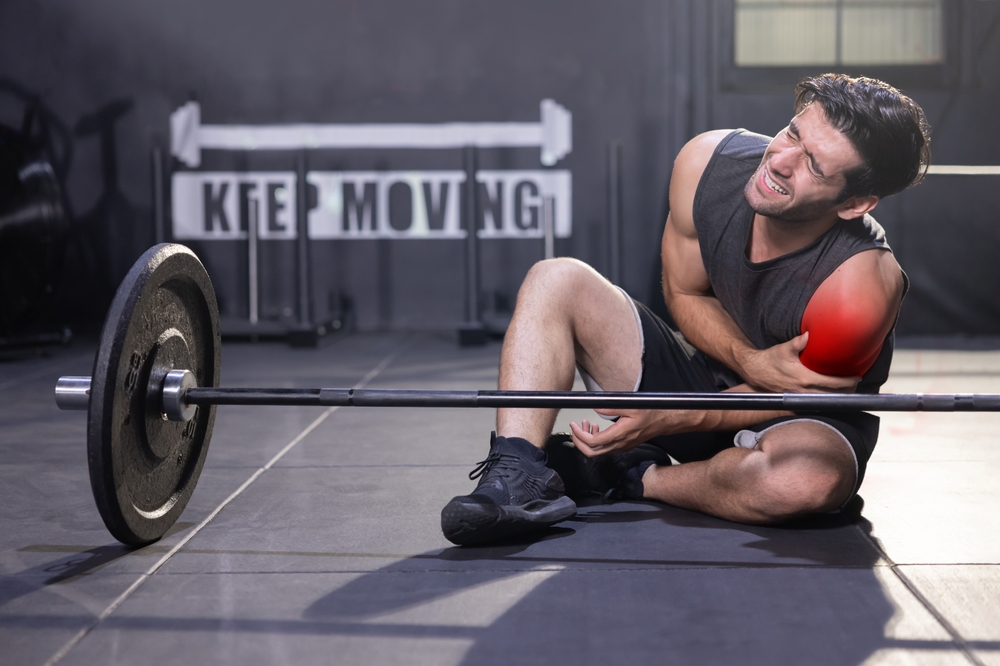
If you’ve ever noticed your shoulder starting to ache during or after a gym session, you’re not alone. Shoulder pain is one of the most common complaints among people who lift weights, and it often develops gradually rather than from one specific injury. Whether you’re training recreationally or preparing for competition, understanding why the pain has developed can help guide the right approach to treatment and getting back to training comfortably.
Why Shoulder Pain Builds Gradually
Most shoulder pain in the gym develops over time rather than from one single movement. The shoulder relies heavily on muscle strength and coordination to stay stable under load, and when demands increase faster than the body can adapt, symptoms develop. A common presentation is rotator cuff tendinopathy, where the tendons around the shoulder become irritated from load exceeding what they’re currently ready for. Research suggests tendon-related pain is better understood as a load management issue rather than a purely inflammatory condition (Cook & Purdam, 2009) — which has real implications for how it should be treated.
What’s Usually Driving the Pain
Changes in training load are one of the most common reasons shoulder pain develops. Returning after time off, increasing weights too quickly or adding more training volume without enough recovery can all ask more of the shoulder than it’s ready to handle. Fatigue can also play a bigger role than most people realise. As it accumulates across a training week, control reduces and load gets distributed differently than it would in a fresh state, often onto structures less equipped to handle it. That’s one reason shoulder pain can seem unpredictable—it might flare up during one session, then barely be noticeable during the next. Underlying strength gaps compound things further, with certain muscles not contributing effectively and others picking up the slack until they can’t anymore.
Why It Often Doesn’t Settle on Its Own
Taking a break often settles the pain, but it doesn’t improve the shoulder’s capacity to handle load. So when you return to the same training, the symptoms often come back as well. Research into shoulder conditions consistently shows that exercise-based rehabilitation is one of the most effective approaches, particularly when focused on strengthening and progressive loading (Littlewood et al., 2013). The Lewis (2016) framework for rotator cuff related shoulder pain emphasises that management needs to account for the uncertainty in diagnosis and focus on what the shoulder can currently do rather than what might be structurally wrong with it.
What Actually Helps
In most cases, the goal isn’t to stop training altogether. Small changes to exercises, range of movement or load can keep you training while giving the shoulder a chance to settle and build back up. From there, exercise rehabilitation focused on rebuilding strength through the rotator cuff and surrounding muscle groups helps distribute load more effectively. Progression needs to be gradual, and restoring confidence in movement is part of the process too — the hesitation that develops after repeated pain episodes can persist well after the physical issue has improved.
Where Physiotherapy Fits In
The role of physiotherapy is to identify why shoulder pain has developed and what factors may be contributing to it. From there, exercise rehabilitation can be tailored to improve strength, restore load tolerance and support a gradual return to training. For gym and sports injuries, this also means considering the specific movements, loads and training demands that are aggravating the shoulder. Because every shoulder and every training program is different, management should be based on the individual’s symptoms, goals and the demands of their sport or activity.
When Should You See Someone?
It’s worth booking in if you:
- Have had shoulder pain for more than a couple of weeks
- Find certain movements consistently hurt
- Are avoiding exercises you’d normally do
- Aren’t seeing any improvement
References
Cook, J. L., & Purdam, C. R. (2009). Is tendon pathology a continuum? A pathology model to explain the clinical presentation of load-induced tendinopathy. British Journal of Sports Medicine, 43(6), 409–416. https://doi.org/10.1136/bjsm.2008.051193
Littlewood, C., Bateman, M., Clark, D., Selfe, J., Watson, L., Walton, M., & Smith, B. (2013). A self-managed single exercise programme versus usual physiotherapy treatment for rotator cuff tendinopathy: The SELF study. Clinical Rehabilitation, 30(7), 686–696. https://doi.org/10.1177/0269215515593784
Lewis, J. (2016). Rotator cuff related shoulder pain: Assessment, management and uncertainties. Manual Therapy, 23, 57–68. https://doi.org/10.1016/j.math.2016.03.009
