

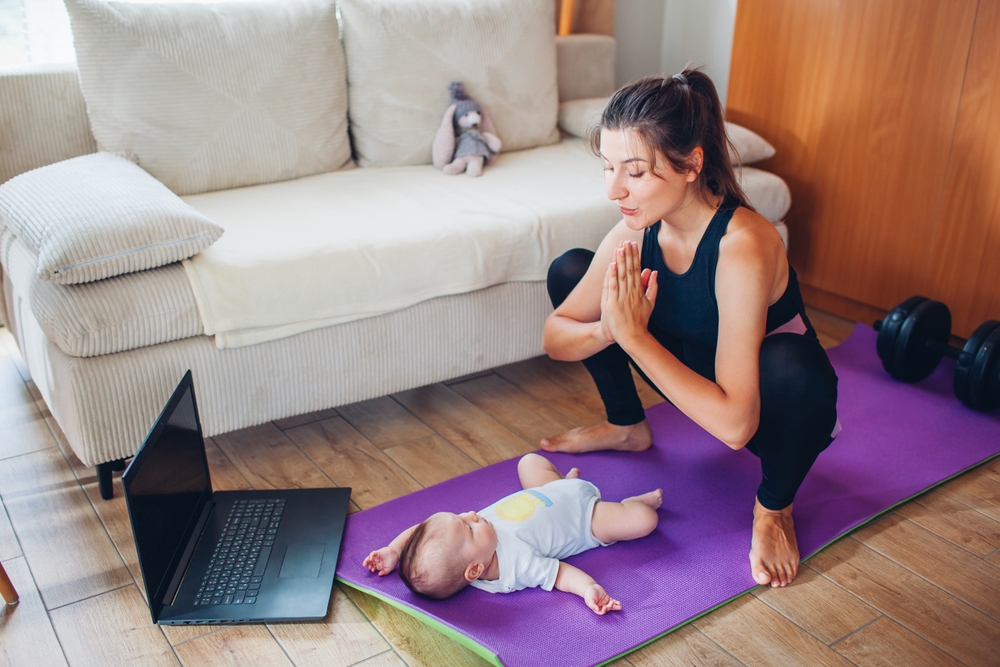
Getting back to exercise after having a baby can be surprisingly difficult to navigate. You might feel ready to do more, but be unsure what is appropriate, how quickly to progress, or what to make of symptoms that weren’t there before pregnancy.
The traditional six-week postnatal check is an important point in recovery, but six weeks isn’t a universal green light for everyone to return to every type of exercise — some women may need more or less time. Recovery depends on your pregnancy, birth, symptoms, previous activity and what you’re hoping to return to.
For higher-impact exercise such as running, guidance recommends looking at function and symptoms as well as time postpartum, rather than relying on a date alone (Goom et al., 2019).
What might you notice when you start exercising again?
Sometimes you don’t notice a problem until you start asking more of your body.
You might experience urinary leaking, pelvic heaviness or pressure, pain, reduced strength or difficulty controlling movements that previously felt straightforward. You may also simply find that your current exercise tolerance isn’t where it was before pregnancy.
These symptoms don’t necessarily mean you need to stop exercising altogether, but they are worth paying attention to — particularly if they persist, worsen as you increase activity or are limiting what you can do.
Pelvic floor muscle training has good evidence for treating urinary incontinence in women (Bø & Herbert, 2013; Dumoulin et al., 2018). However, not every postnatal symptom has the same cause or needs the same approach.
So where do you start?
There isn’t one postnatal exercise program that suits everybody.
For some women, getting moving again may begin with walking, gentle mobility and gradually increasing everyday activity. Others may already be comfortable with these things and be ready to start rebuilding strength.
Strength work may include the pelvic floor, abdominal muscles, hips and lower body, depending on your symptoms, current capacity and the activities you want to return to.
From there, exercise can gradually become more demanding. If your goal is to return to running, jumping or heavier lifting, your program needs to prepare you for those particular demands rather than simply waiting until a certain number of weeks has passed.
What about returning to running?
Running places different demands on the body than walking or lower-impact exercise, so being comfortable with one doesn’t necessarily mean you’re ready for the other.
The postnatal return-to-running guidelines by Goom and colleagues recommend a graded return to running from around three months postpartum at the earliest, provided appropriate criteria are met, rather than routinely returning at six weeks (Goom et al., 2019).
Assessment may consider things such as pelvic floor symptoms, strength and your ability to tolerate impact and load before gradually building running volume and intensity.
Importantly, this isn’t a pass-or-fail test. The aim is to work out what you’re currently able to tolerate and what may need some attention before progressing further.
Why can it feel harder than expected?
Pregnancy and birth aren’t the only things affecting your return to exercise.
Sleep disruption, feeding, caring for a baby, changes in routine and simply having less time to exercise can all influence how much activity feels manageable.
Your previous exercise history matters too. Someone returning to running after exercising throughout pregnancy may need a very different approach from someone who hasn’t run for a year.
Progress therefore won’t necessarily look the same from one person to the next — or even from one week to the next.
Where does pelvic health physiotherapy fit in?
A postnatal physiotherapy assessment can look at pelvic floor function, abdominal recovery, strength, symptoms and the physical demands of the exercise or sport you want to return to.
From there, rehabilitation can be tailored to what you actually need. That might involve pelvic floor rehabilitation, rebuilding strength, managing pain or other symptoms, or gradually preparing for higher-impact exercise.
Physiotherapy may be worth considering if you’re experiencing leaking, pelvic heaviness or pressure, pain, or difficulty progressing your activity, or if you’re unsure how to approach returning to higher-impact exercise.
The aim isn’t to get everybody back to exercise in the same way or on the same timeline — it’s to work towards your activities and goals based on how you’re recovering.
References
Bø, K., & Herbert, R. D. (2013). There is not yet strong evidence that exercise regimens other than pelvic floor muscle training can reduce stress urinary incontinence in women: A systematic review. Journal of Physiotherapy, 59(3), 159–168.
Dumoulin, C., Cacciari, L. P., & Hay-Smith, E. J. C. (2018). Pelvic floor muscle training versus no treatment, or inactive control treatments, for urinary incontinence in women. Cochrane Database of Systematic Reviews, (10), CD005654.
Goom, T., Donnelly, G., & Brockwell, E. (2019). Returning to running postnatal: Guidelines for medical, health and fitness professionals managing this population. Journal of Women’s Health Physical Therapy, 43(1), 13–25.
