

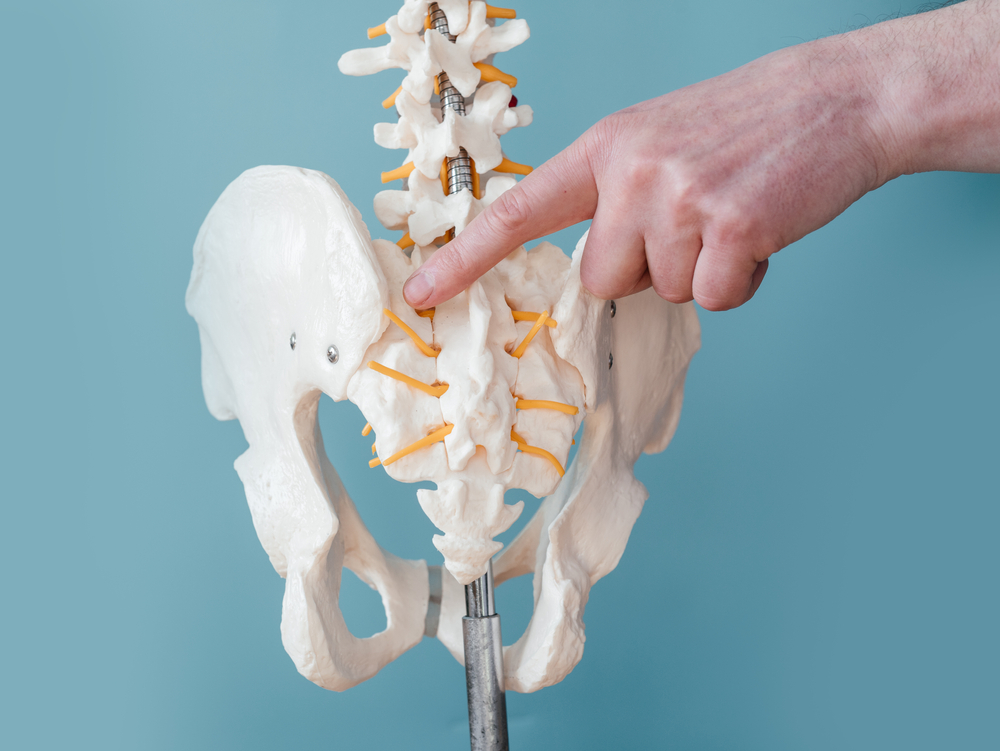
What is Sacroiliac Joint pain?
Sacroiliac joint (SIJ) pain refers to pain arising from the sacroiliac region, commonly presenting as unilateral or bilateral buttock or lumbopelvic pain. The SIJ connects the sacrum with the ilium and contributes to load transfer between the spine and lower limbs.
Diagnosing the SIJ as the specific pain source can be difficult because symptoms can overlap with the lumbar spine, hip and surrounding soft tissues. SIJ pain should therefore be considered within a broader assessment rather than assuming that a structural abnormality is responsible.
Evidence suggests that palpation-based tests for SIJ position or movement have limited reliability. Clusters of pain-provocation tests can increase suspicion of SIJ-related pain but cannot definitively identify the SIJ as the pain generator.
SIJ biomechanics
The SIJ is a relatively stiff and stable joint with very small amounts of movement, generally only a few degrees or less. Its primary role is to transfer and distribute forces between the trunk and lower limbs while resisting shear across the pelvis.
SIJ stability can be understood through:
- Form closure: stability provided by joint anatomy, joint surfaces and ligaments.
- Force closure: additional compression and stability created by muscles, ligaments and external forces.
Although these concepts help explain pelvic load transfer, they do not mean that a patient’s SIJ is necessarily “unstable” or “out of alignment.” There is limited evidence supporting clinical diagnoses such as pelvic torsion, “upslips,” “downslips” or other positional abnormalities based on palpation alone.
Therefore, biomechanics should be considered as one part of the clinical picture rather than the sole explanation for pain.
The biopsychosocial approach
Pain is influenced by interacting biological, psychological and social factors.
Biological factors
Assessment should consider:
- pain location and irritability;
- lumbar spine and hip contribution;
- SIJ pain-provocation testing;
- neurological signs;
- strength and physical capacity;
- activity and occupational demands;
- sleep and previous injury.
Psychological factors
Important factors include:
- fear of movement;
- fear of damage;
- catastrophising;
- anxiety or distress;
- low confidence in movement;
- expectations about recovery;
- avoidance of activities.
Social factors
Consider:
- work demands;
- family responsibilities;
- social support;
- workplace or financial pressures;
- access to healthcare;
- expectations from employers, coaches or family.
These factors do not mean that the pain is psychological. Rather, they can influence pain sensitivity, behaviour, physical activity and disability.
Treatment
Education and load modification
Education should explain that the SIJ is a strong, load-bearing joint and that pain does not necessarily indicate tissue damage or pelvic displacement.
Patients should generally avoid unnecessary prolonged rest. During an irritable phase, aggravating activities can be temporarily modified while maintaining tolerable movement and activity.
The goal is:
modify load → maintain activity → progressively increase load tolerance.
Exercise and progressive loading
Exercise is often the foundation of rehabilitation. Depending on the patient’s presentation, this may include:
- walking and aerobic exercise;
- trunk and hip strengthening;
- squats;
- bridges;
- split squats;
- step-ups;
- deadlift variations;
- loaded carries;
- running, jumping and sport-specific exercises.
The aim is not simply to “stabilise” or reposition the SIJ. Instead, exercise should improve strength, endurance, confidence and tolerance to physical load.
Exercise should be individualised according to the patient’s symptoms, physical capacity and functional goals.
Manual therapy
Mobilisation or manipulation may provide short-term symptom relief for some patients. However, it should not be explained as permanently “putting the SIJ back into place.”
Manual therapy is best used as an adjunct to active rehabilitation, particularly when it helps reduce symptoms sufficiently to allow movement and exercise.
Psychologically informed rehabilitation
Where fear, catastrophising or avoidance are contributing to disability, treatment should address these factors directly.
Strategies may include:
- pain education;
- graded exposure to feared movements;
- improving self-efficacy;
- reducing unnecessary avoidance;
- behavioural strategies;
- cognitive-behavioural approaches.
The goal is to help patients understand that movement and loading can be progressively restored without requiring perfect pain elimination first.
Return to function
Pain reduction should not be the only measure of recovery. Rehabilitation should progressively restore the person’s ability to perform meaningful activities. A practical progression is:
- Reduce irritability
Maintain comfortable daily activity and modify aggravating loads. - Restore movement confidence
Gradually reintroduce movements the patient has been avoiding. - Build physical capacity
Progress resistance training, aerobic fitness, trunk and hip strength. - Reintroduce meaningful loads
Increase lifting, running, jumping or other work/sport-specific demands. - Return to full function
Progress toward normal occupational, sporting and recreational activities.
Progression should be based on improving capacity, confidence, activity tolerance and recovery, rather than pain alone.
For example, a patient may experience mild discomfort during a squat but still be able to complete the exercise safely, recover appropriately and progressively increase their strength. In this situation, complete avoidance of the movement may not be necessary.
Conclusion
SIJ pain should be managed as a multifactorial lumbopelvic pain condition, rather than simply as a mechanically “misaligned” joint. The SIJ has an important role in load transfer, but its movement is small and current evidence does not support routinely diagnosing painful SIJ dysfunction through pelvic asymmetry or positional palpation.
Management should focus on education, appropriate load modification, progressive exercise, addressing psychological barriers and gradually returning the patient to meaningful activities. Manual therapy may be useful for short-term symptom modulation but should complement, rather than replace, active rehabilitation.
