

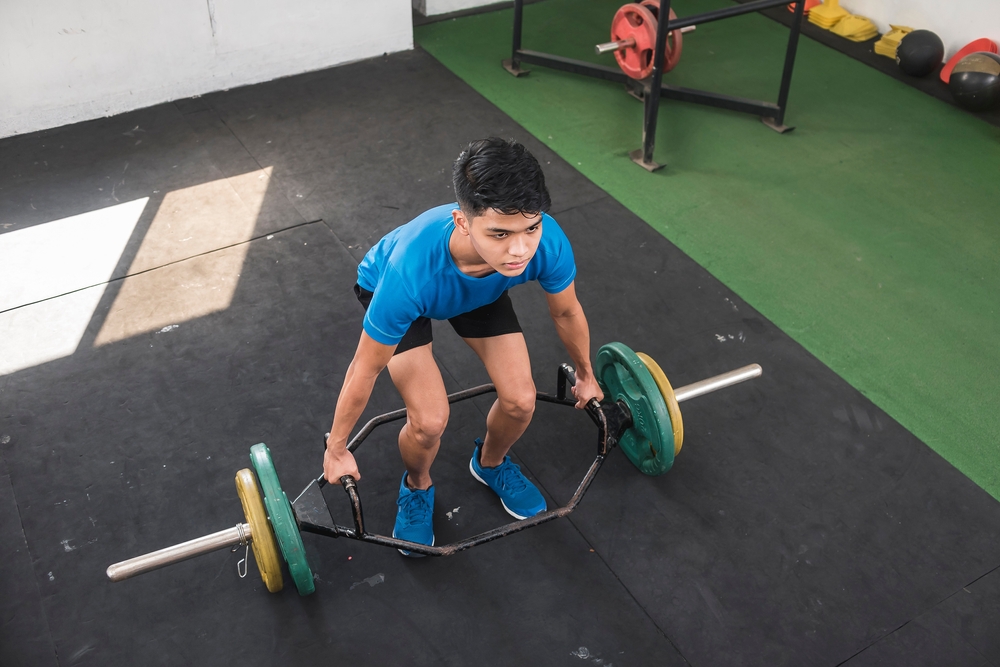
For many parents, the idea of their teenager lifting weights can raise a few questions. Is it safe? Will it affect their growth? And how young is too young?
Appropriately designed and supervised strength training can be a valuable part of physical development for teenagers, whether they play competitive sport or simply want to become stronger and more confident with exercise.
And strength training doesn’t necessarily mean lifting heavy weights. It can include bodyweight exercises, resistance training and learning fundamental movements such as squatting, pushing, pulling, jumping and landing.
Does strength training stunt growth?
This is probably one of the most common concerns around teenagers and strength training, but the evidence does not support the idea that appropriately performed strength training stunts growth.
Research and professional guidelines support appropriately designed and supervised resistance training for children and adolescents, with benefits including improvements in muscular strength, power and physical performance.
What is important is that teenagers don’t simply copy an adult gym program or try to lift as much weight as possible. They are not smaller adults. Training needs to take into account their physical development, previous experience, sporting demands and current ability.
What age can teenagers start strength training and plyometrics?
There isn’t one specific age when a young person suddenly becomes ready to start strength training or plyometrics.
More important is whether they can follow instructions, learn appropriate technique and perform exercises with control. A teenager who has several years of sporting and training experience will have very different needs from someone of the same age stepping into a gym for the first time.
For a beginner, strength training might start with bodyweight exercises and relatively simple movements before gradually introducing external resistance.
Plyometrics can be approached in much the same way. Learning to jump and land with control may come before progressing to faster, more complex or higher-intensity movements.
Why is strength training important for teenagers?
The teenage years involve significant changes in muscle, bone, coordination and movement skills. Appropriately programmed strength training provides a way to develop these qualities progressively.
Stronger muscles and bones
Strength training helps develop muscular strength while providing loading through the body that supports healthy bone development.
Australian physical activity guidelines recommend that young people aged 5–17 include muscle- and bone-strengthening activities at least three days per week. That doesn’t necessarily mean three gym sessions — running, climbing, push-ups and other bodyweight exercises also count.
Better movement skills
Strength training can help teenagers learn fundamental movement skills such as squatting, hinging, pushing and pulling, alongside skills such as jumping, landing, accelerating, decelerating and changing direction.
These movements provide a useful foundation for both sport and other forms of physical activity.
Greater confidence and independence
Learning how to perform exercises correctly, choose an appropriate resistance and understand how to progress their training can also build confidence in the gym.
Importantly, the aim isn’t to have someone constantly telling them what to do. It’s to give teenagers the skills and knowledge to eventually train safely and confidently themselves.
Strength training and sport
For teenagers involved in sport, strength training can be particularly valuable.
Soccer, basketball, athletics and many other sports require young athletes to produce and absorb force, accelerate, decelerate, jump, land and change direction.
Developing strength provides a foundation for these movements and can form an important part of strength and conditioning for young athletes. Research supports resistance training for improving strength and power, with potential improvements in qualities such as jumping, sprinting and agility.
Strength training doesn’t replace actually playing and practising their sport. Instead, it can be used alongside sports training to help prepare for some of its physical demands.
Where do plyometrics fit in?
Plyometrics involve movements where force is produced or absorbed quickly, including jumping, hopping and bounding.
Think of a soccer player jumping for a header, a basketball player taking off for a rebound or an athlete landing and rapidly changing direction.
Strength and plyometrics therefore train related but different qualities. Strength training develops the ability to produce force, while plyometric training develops the ability to produce and absorb force quickly.
Like strength training, plyometrics can be progressed. A teenager might begin with relatively simple jumping and landing drills before moving towards faster or more demanding exercises as their ability develops.
Plyometric exercises are also commonly included alongside strength, balance and agility work in broader exercise-based sports injury-prevention programs for young athletes.
Can strength training help prevent injuries?
No training program can prevent every sporting injury.
What strength and conditioning can do is help develop the strength, movement control and physical capacity needed to cope with the demands of sport.
Training load matters here too. Teenagers may be juggling school sport, club sport, gym sessions and other activities at the same time. Sudden increases in how much training they’re doing can be significant, so recovery, sleep and their overall training load need to be considered alongside additional strength sessions.
Strength training after an injury
Strength and plyometric training can also play an important role in exercise rehabilitation and returning to sport.
Once pain has settled, a young athlete may still need to rebuild the physical qualities their sport requires. For someone returning from a knee injury, for example, that might include lower-limb strength, jumping and landing, change of direction and tolerance to increasing training loads.
A physiotherapist can assess what is appropriate at each stage and progressively introduce more demanding exercises as rehabilitation continues.
What should a teenage strength program look like?
There isn’t one program that suits every teenager. A 13-year-old who has never trained before shouldn’t necessarily be doing the same program as a 17-year-old with several years of gym and sporting experience.
Programming should consider:
- age and physical development
- previous training experience
- sporting participation
- current strength and movement ability
- previous injuries or pain
- individual goals
- overall training load and recovery.
Once exercises can be performed confidently and consistently, they can gradually become more challenging. That might mean changing the repetitions, resistance, speed or complexity — not simply putting more weight on the bar.
And what if they don’t play sport?
They can still strength train.
For teenagers who aren’t interested in organised sport, the gym can provide another way to be physically active and learn skills they can continue using into adulthood.
It can also give teenagers who don’t particularly enjoy running or team sports another option for exercise — and one they may actually enjoy doing.
Ready to get started?
If your teenager is interested in strength training, plays sport, or simply wants to become stronger and more confident with exercise.
We can assess where they are currently at, understand their goals and sporting demands, and help develop an individual strength and conditioning program that is appropriate for their age, experience and ability.
The aim is to give them the knowledge, skills and confidence to train safely, develop their physical capacity and start their strength and conditioning journey on the right foot.
